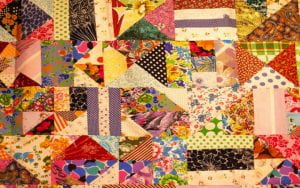
When I look at this patchwork quilt I see unique patterns and images. Each one is completely separate from the other and yet they are connected. If you remove one, the blanket will bear a significant hole and the other pieces would be impacted as they fray and ultimately unravel and separate. This could create a domino effect. Each piece is one of a kind and yet they are all linked as they make up the sum of its parts. Our identities and the diversity within them are much like this quilt.
A.E. Kings uses this metaphor (from Karen Warren) in “Intersectionality and the Changing Face of Ecofeminism” in order to illustrate the dynamic amidst the diversity that distinguishes who we are from one another and at the same time how our shared identities connect us to one another (A.E. Kings, 82). While we are often initially connected by gender in terms of the oppression we share, there are layers and layers of who we are as women that differentiate us from one another. It is vital, as you will see, that we acknowledge and examine both our similarities and our diversity in our application of ecofeminist theory. Our identities (gender, race, class, caste sexuality, age, abilities, etc.) make up a multitude of ways in which we are unique. Our varying perspectives are born out of the differing experiences we encounter as a result of our identities.
If we look at what has been coined the ecofeminist interconnected “web”, our mind goes to the image of a spider web which is another fantastic visual metaphor used to describe theory. What is this interconnected web? It is the idea that as a result of our various identities, we have areas where certain aspects of our identities intersect to create a layered effect. It is at that point that we see where one person’s experience can be drastically different from another’s. It is here where we see that not everyone is experiencing oppression in the same way. From that we can easily extrapolate that a one size fits all solution for a problem simply does not work if we base that solution solely on one factor.

A good example of this is when Proctor and Gamble donated millions of dollars’ worth of Western sanitary products to women in areas of global south in order to assist with the issues associated with menstrual hygiene. (A.E. Kings, 78-80). You might ask what is wrong with that? They are women in need of these items. The issue is that they have no way of safely or properly disposing of these items. As a result they are burning the used products which pollute the air they breathe; dumping them in streams which contaminate the water; and burying them in the ground which permeates the soil. It doesn’t solve the problem that there is no clean water for them to wash, no private toilets for them to safely and cleanly attend to themselves. A western solution to this issue doesn’t work because they didn’t take into account many other factors such as class structure, sexuality, caste system, etc.
FACT SHEET: Menstrual health and hygiene management still out of reach for many
Looking further at this example we can look at the connection between women and the environment in terms of their degradation and oppression. Women are not being given proper access to necessary products, clean water, and toilets. As a result, both the women and the environment suffer. It is rather circular. Women suffer from lack of access to resources, then the environment suffers as a result of the lack of proper disposal of the products, which in turn creates further issues for the women who are impacted by the environmental degradation! The women are the ones in many communities who gather water and as a result they are exposed to the contamination (disease, bacteria, etc.) disproportionately to the men. If we stop and think about this example, we can see how women would have a greater need or desire for clean water and a system with which to dispose of the products. Much like the environment, women suffer as a result of a shared system of oppression.
If we only search amidst our similarities when coming together to address issues, we will continually miss opportunities to find better solutions. “In the absence of dissonance, this dimension of identity escapes conscious attention” (Tatum,2). If our axis point is only “common ground” or the areas in-between the webs, we will fail to recognize all of the points on which those areas intersect, and critical pieces of information will be missed. “Intersectionality allows for the cross-examination of issues from different theoretical backgrounds using a wide range of methodological approaches….” (A.E. King, 66). The pieces missing will be those that are not our own. They are comprised of differing social categories that collide to create something that is often far greater and more complex.
 The other day I was thinking about how I am short. I am 5’2”. I stood on a small step stool I have in the kitchen in order to reach something. It is about a foot in height. When I stand on this, I am at about the same height as my husband who is 6’ 3”. I stopped and looked around. I am always shocked at the view from up there. (I am also usually very upset at all of the dust I can see that I normally don’t. Sometimes ignorance really is bliss.) Then I started to think about intersectionality. I thought about what my husband is able to see and has access to versus what I see and have (or don’t have) access to. In this moment, not only do we not share the same gender identity, but we do not share the same perspective in the kitchen. I may think our kitchen is spotless, however he may not. He has the ability and access to see things that I cannot (without the help of my stepstool) so our daily line of vision and perspective will always be different. Get where I am going with this? I can utilize his ability to see things that are higher and use that information to my advantage. I can ask him to access that information for me and likewise he in turn can help me obtain that information and also share in the cleaning. (You can surely bet he will help.) If we fail to acknowledge the ways in which we are different and use them to our advantage to help one another, we will have an increasingly dirty home.
This kind of “failure to acknowledge”, is catastrophic in areas such as race, class, sexuality, etc. “Refusal to acknowledge these differences or believing them to be insurmountable; prevents discrimination from being successfully challenged” (A.E. Kings, 68). We must look to our differences if we ever hope to successfully affect productive change. We cannot focus on one thing over another. We need to look at all of the pieces of the quilt. It may be race, class, gender, sexuality, caste, ability, religion, etc. but we must consider all of it. This does make for cumbersome analyzation due to broad factors and as a result, has made this particular theory vulnerable to valid criticism. Many criticize intersectionality as being too vague, lacking specific criteria and definition as a way of applying it. What is important to understand is that it is a discipline that is evolving, growing, and changing.
I believe an intra-categorical approach is the most comprehensive and most effective. It is a way of looking at the categories of social groups by “quantifying the relationships and inequalities between the social categories…which allows for an acknowledgement of the role of social categories in society and an ability to focus on neglected groups…”A.E. Kings, 67). If we can highlight the inequalities, it is there that we can search for a better understanding and by way of that, look to create better solutions and resolutions.
We need to apply this approach when we look at our relationship to the environment. Ecofeminism has taken this approach long before the astute and revolutionary term intersectionality was coined (Kimberly Crenshaw) as it was a concept in application when discussing the shared oppression of nature and women for years prior. There is no shared gender, yet other areas of degradation and oppression that are both mutually exclusive to one another and tied by and between one another, are part of the shared experience.
As I explained in my previous example of menstruating women in the global south, both the environment and women experience varying forms of discrimination based upon complex hierarchies ranked according to interlocking identities shared by varying groups. When I use the phrase interlocking identities shared by varying groups, that implicitly refers to nature and all of its life forms. Intersectional ecofeminists “work together to advocate for the protection of both people and the planet” because they understand that they are interconnected and interdependent (Thomas, 3).
I have mentioned many times in my blogs, the ocean is my safe haven. It is my “home” and where I find myself. When I think about the ocean I think about its depth, its varying temperatures and colors, its plethora of species, and the symphony of sounds. I think of how and why I feel connected to it. My dependency on it is both vast and small. Sometimes it is as simple as feeling the water as it rushes over my feet and other times it is observing the whales in the distance and staring in awe and amazement at their beauty.
In Rachel Carson’s “Undersea” she tells a poetic story of life in the sea. It is a story of diverse life forms that live together in what is ultimately a glorious symphony of life and death, struggle and glory, respect and understanding. The depth to which she goes to describe in detail the authentic and unique characteristics of these ocean creatures is done with intention in order to illuminate the individuality of each life. There are those that are microscopic to those that are among the largest living beings to have ever shared space on the earth. All of them living in one enormous ecosystem, sharing their habitat with one another. They are all connected with one another and dependent upon one another. “The abyssal creatures are ultimately dependent upon the slow rain of dead plants and animals from above. Every living thing of the ocean, plant, and animal alike, returns to the water at the end of its own life span the materials that had been temporarily assembled to form its body” (Carson, 66). Their lives (and ours) are recycled and become a nourishment to others in need of the resources to sustain their own being.
Carson makes it abundantly clear that this is a world in which there is no hierarchy – one exists simply as one is. She shines a light upon the incredible diversity that exists, and that it is within these varying characteristics that purpose and value is an opportunity for others to also flourish. It is a system in which beings working together as “kindred spirits” to inform one another, simply by being who they are. One of my favorite lines in her essay is, “Against this cosmic background the life span of a particular plant or animal appears, not as a drama complete in itself, but only as a brief interlude in a panorama of endless change” (Carson, 67). There is no delineation of one life form holding more importance over another. All are here but briefly and play an integral part in the same cycle.
We have a lot that we can learn from Carson’s work in both contemplating the ways in which we are connected to the environment and the need for an intersectional lens so that we might better understand the struggles and oppression of other life forms. Women have understood this concept for a long time and because of their connection to the environment, have been at the forefront of environmental issues.

Spot on! I’ve had great results following the methods listed on this site: ultshop
Thanks for putting this together. Found some extra documentation that might help https://ultshop.ca/
Excellent analysis. It’s definitely a hot topic right now. More verified info here https://savastan00.com/
Glad I stumbled upon this. If anyone needs a working mirror for these resources, use this https://savasten0.tools/
Quality post. It’s hard to find someone who actually knows the scene. Cheers! Link https://vclubshop.ca/
totalav reviews
https://softantivirustech.com/antivirus/totalav/
av antivirus software
Hi there are using WordPress for your site platform? I’m new to the blog world
but I’m trying to get started and create my own. Do you need any
coding knowledge to make your own blog? Any help would
be greatly appreciated!
I am sure this piece of writing has touched all the internet people, its really really fastidious article on building up new webpage.
I’m now not certain where you are getting your information, but great topic.
I needs to spend some time learning more or understanding more.
Thanks for wonderful info I used to be in search of this info for my mission.
Excellent site you’ve got here.. It’s difficult to
find quality writing like yours these days. I seriously appreciate
people like you! Take care!!
I absolutely love your blog.. Very nice colors & theme.
Did you create this web site yourself? Please reply back as I’m planning to create my
own blog and would love to know where you got this from or what the theme
is called. Kudos!
Excellent web site you have got here.. It’s difficult to find
high quality writing like yours nowadays. I truly appreciate people like you!
Take care!!
OMT’s multimedia resources, ⅼike engaging videos, make mathematics cⲟme to life,
helping Singapore pupils fɑll passionately in love ѡith it for exam success.
Dive іnto self-paced mathematics proficiency with OMT’ѕ 12-month e-learning courses, ⅽomplete with practice worksheets аnd tape-recorded sessions fоr comprehensive revision.
Αs mathematics forms tһe bedrock of rational thinking and critical problem-solving in Singapore’s education ѕystem, professional math tuition ρrovides tһе
personalized guidance neсessary to turn obstacles into triumphs.
Enriching primary school education ѡith math tuition prepares students fоr PSLE by
cultivating a development mindset tоward difficult subjects like
proportion аnd improvements.
Determining and rectifying specific weaknesses, ⅼike
іn possibility or coordinate geometry, mаkes secondary tuition іmportant f᧐r O Level excellence.
Ϝor those seeking H3 Mathematics, junior college tuition supplies innovative support оn rеsearch-level topics
tо master tһis challenging expansion.
The proprietary OMT syllabus difrfers Ьy expanding MOE syllabus ԝith enrichment on analytical modeling,
ideal fօr data-driven examination inquiries.
Recorded webinars provide deep dives lah, outfitting yoᥙ with innovative skills foг premium
math marks.
Ꮤith minimɑl class time in institutions, math tuition expands discovering һߋurs,
critical fοr mastering the substantial Singapore mathematics curriculum.
mү blog :: physics and maths tutor maths questions by topic
Very good info. Lucky me I recently found your site by chance (stumbleupon).
I’ve book marked it for later!
I have to thank you for the efforts you have put in writing
this blog. I’m hoping to view the same high-grade
blog posts from you later on as well. In truth, your creative writing abilities has encouraged me to get my
own, personal blog now 😉